
Why we use WooCommerce to build ecommerce websites
WooCommerce powers millions of online stores. Here's why it's our platform of choice for ecommerce websites — and what to consider before you build.
Read More »Blog
Craig Greenup 20/04/26, 19:07

Running a charity? Then your website is usually the first place people go when they want to learn about your cause. For many visitors, this is where they decide to donate, volunteer, seek support — or simply click away.
That makes your website one of the most important assets your charity has. And one that it really pays to get right.
In this guide, we look at what the best charity websites do well, share some of our favourite charity website examples and walk you through how to build — or rebuild — a website that genuinely supports your organisation.
We’ll be covering:
Like any website, a charity website needs strong design, clear messaging and a good user experience. But there are some key tasks that great charity web design does particularly well.
The best charity websites are good at telling visitors what an organisation does, who it helps and why it matters — quickly, without forcing people to hunt for answers.
This is especially important for smaller or more specialist charities, where the cause may be unfamiliar to a lot of visitors.
If people can’t understand what you do within seconds of landing on your homepage, they’ll leave. So you need clear messaging and calls to action that direct people to the right content.
When a user lands on a charity website, they make a quick judgement. Is this organisation legitimate? Can I trust them with my donation? Are they genuinely making a difference?
The best charity websites answer these questions immediately with a homepage that clearly shows:
Without these trust signals, even the most compelling cause can struggle to convert website visitors into supporters.
This sounds obvious. But you’d be surprised how many charity websites make the donation process harder than it needs to be. Buried donate buttons. Confusing forms. A user journey that feels clunky on mobile.
Every point of friction between a willing donor and a completed donation is a problem. So great charity websites remove every unnecessary barrier.
For UK-based charities, a Gift Aid sign up box is an essential feature of the donation process.
The best websites feature an eye-catching Gift Aid declaration that website users can complete in just one click. This increases the value of donations without derailing a payment.
Facts and figures matter. But emotion is what moves people to act. The best charity web design blends data with storytelling — pairing impact statistics with real human stories to give visitors both rational and emotional reasons to get involved.
Most charities have more than one type of website visitor: donors, volunteers, beneficiaries, corporate partners, journalists… A good not-for-profit website caters for all of them — with clear pathways and relevant content for each user group.
Looking for charity website design inspiration? There are some genuinely brilliant non-profit websites out there. Here are some of our favourites — and the things each one does well.
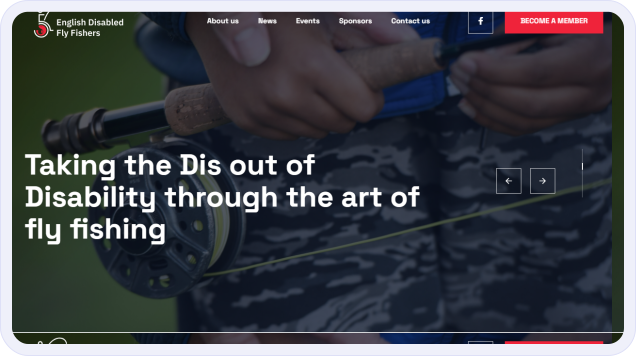
When English Disabled Fly Fishers came to the Radical team for a new website, we leaned into the visual identity of the sport. We incorporated wavy, watery backgrounds and an eye-catching (or should that be fish-catching?) micro-animation.
As well as evocative visuals, we created dedicated spaces for news and events to keep the community connected. We also built an online membership application form so prospective members can join the charity directly through the website.
The end result was a site that reflected English Disabled Fly Fishers’ values and made it easy for visitors to take action.
The National Trust manages hundreds of properties, millions of members and a huge range of activities. That’s a lot to pack into a single website. Yet the National Trust site feels calm and easy to navigate.
Great photography does a lot of the heavy lifting — which makes sense for a charity whose entire proposition is about beautiful places worth preserving. The membership sign-up flow is smooth, and a logical menu means visitors can find exactly what they’re looking for in seconds.

Dramatic photography, strong storytelling and a clear sense of mission. The RNLI website brings visitors straight into the emotion, but supports that journey with practical tools — like the customisable donation box in the hero section.
This website is also a great example of authority-building. Landing on this charity site, you’re in no doubt about what the organisation does, how well it does it and why your support makes a difference.

A strong example of designing for a specific audience rather than a generic “web user”. Age UK’s visitors skew older, so the site prioritises accessibility: clear structure, simple language, generous text sizing and easy-to-find phone numbers for those who’d rather talk to someone than fill out a form.

Here we have another excellent example of web design for non-profits. Centrepoint is a youth homelessness charity working across the UK.
Its website features bold branding that helps it stand out from other charity web designs. It also offers two clear paths throughout the homepage — one for people seeking help and one for people looking to offer their support. It’s simple, but very effective.

Leading environmental charity, WWF, has a website that features a wide range of functionality. It supports donations, membership subscriptions, animal adoptions, an e-commerce store and an online lottery. There’s also a ton of information about the animals and habitats WWF helps to protect — and a handy environmental footprint calculator.

The thing we like most about the Oxfam website? How stark and impactful its hero section is.
With the use of photography, bold typography and a minimalist approach, Oxfam focuses our attention on one cause and one key action. It simplifies the decision-making process for a visitor, increasing the likelihood that they’ll donate, right there, right then.

Barnardo’s works with some of the UK’s most vulnerable children and young people — and the website reflects that responsibility carefully. The design is warm and approachable without being insensitive or naïve.
We particularly like the donation page. Website visitors can select monthly or one-off payments, with each amount linked to a real-world example of what that money could do for a child. It’s emotive and shows people exactly what difference their support can make.

Mind’s website has a couple of important jobs to do: it needs to support people who may be in genuine distress, right now, while also engaging donors and campaigners. That’s a difficult balance that the site handles well.
Support resources are front and centre, so someone in crisis can find help quickly. But scroll down the homepage, and you’ll find plenty of content for other audiences, too — including a quick and visual summary of how the organisation spends donations and a link to their latest annual review.

So we’ve seen some of the best charity websites out there right now. These websites can provide great inspiration for your own non-profit web design.
But it’s also worth looking at what not to do. Because even charities with great causes fail to generate interest and support when they fall prey to one of these common charity web design pitfalls.
If your homepage copy leads with organisational history rather than impact, visitors will bounce away from your website. So lead with your cause and the people you help. Make it about them, not you.
Over half of UK web traffic now comes from mobile devices. If your donate button is hard to tap, your resources are buried or your pages take forever to load on a smartphone, you’re losing website visitors.
People understand that charities don’t always have the biggest budgets. But first impressions still matter. Website visitors are more likely to donate or trust your resources when your website is credible and well-maintained.
Your charity registration number, annual report, accounts and impact data shouldn’t be hidden away in a footer. Feature these trust signals prominently so people can see how you’re using their donations.
Charities sometimes optimise for donors and forget everyone else. Depending on your remit, you may need clear, well-signposted pathways for prospective volunteers, corporate sponsors and the people you help. Otherwise, you speak to everyone (and no one) at the same time.
A charity website that doesn’t rank well in search results can miss a significant source of traffic and potential support. You want to appear when people search for the cause you address, the services you offer or the fundraising events you’re hosting.
If your current charity web design isn’t serving you — or you’re building a new website from scratch — the process doesn’t have to be complicated. But it does require a clear plan of action.
Here’s what to do.
The first step to building a charity website is understanding who the website is for and what you want it to achieve. That means considering the following:
Get clear on your priorities and it’s easier to make website decisions — and communicate your needs to a web design agency.
Before jumping to what you want, it’s useful to take stock of what you already have.
What content is performing well and worth keeping? What pages are confusing, outdated or missing entirely? What does your analytics data tell you about where visitors drop off?
A clear audit saves you from rebuilding problems into a new site — and often surfaces things you didn’t know you needed to fix.
Next, look at non-profit organisation website examples (like the ones we’ve included above). But don’t limit yourself to the not-for-profit sector.
If you see design features or functionality you like — on any website you come across — make a note. It can be much easier to explain what you’re looking for when you have concrete examples to show to your web designer and developer.
Not all web agencies understand the specific challenges of charity web design. Look for one with sector experience, a bespoke approach, and a track record of accessible, responsive, high-performance websites.
Client care is also important. So seek out a web design and development agency that talks in plain English (not tech jargon) and provides a range of (optional) support packages post-launch.
Website content usually includes professional photography, video and well-written copy, all optimised for both website visitors and search engines.
If you don’t have these assets or the in-house expertise to create them, a good web design agency can help — either directly or by pointing you towards the right people.
A website is only as good as the team maintaining it. Before you brief an agency, think about who’ll be responsible for updating the site, publishing new content and keeping information accurate after launch.
That answer affects decisions made during the build — how the CMS is set up, what training you’ll need and how much ongoing agency support to budget for.
A great charity website isn’t just a digital brochure. It’s your most powerful fundraising tool, your primary support channel and the face of your organisation to the outside world.
At Radical, we have decades of experience building bespoke WordPress websites. Our easy-to-manage sites reflect your organisation, improve online visibility and provide a seamless experience for visitors.
If your current website isn’t working for your organisation — or you want to build something new — get in touch with the Radical team today. We’d love to hear about your project.
Charity web design is the process of planning, designing and building a website for a charitable organisation.
It involves the same core disciplines as any web design project — user experience, visual identity, content structure and technical development — but with a focus on the goals that matter most to charities.
That includes building trust, communicating a cause clearly and making it easy for visitors to donate, volunteer or access support.
Charity web development covers the technical side of building a charity website — the code that determines how the site functions, performs and holds up over time.
A well-developed charity website is fast, secure, mobile-friendly and easy to update, with any specialist functionality (donation tools, membership forms, event listings) built to work reliably and intuitively.
There are lots of ways to improve traffic to your charity website. You can link to your website (and encourage people to visit) via social media marketing, email marketing, PR and corporate partnerships.
You can also use SEO to rank well in search engine result pages. That means regularly publishing relevant, optimised content that answers questions your audience is searching for. It also means ensuring your website’s technical foundations are solid — your site should be fast and well-structured.
Start by removing friction. Every extra step between a visitor and a completed donation, volunteer application or sign-up form is an opportunity to lose them.
Make your calls to action prominent and specific. Ensure your forms are short and mobile-friendly. And use real stories and impact data to give people both emotional and rational reasons to act.
Set your KPIs before launch, not after. Decide what success looks like for your charity — more donations, more volunteer enquiries, more people accessing your resources — and track the metrics that reflect those goals.
Google Analytics is a good starting point. Check it regularly, look for patterns and use what you find to make improvements over time.
Static vs dynamic websites: which should you choose?
What is GEO? And what does it mean for your website?
14
Sep
WooCommerce powers millions of online stores. Here's why it's our platform of choice for ecommerce websites — and what to consider before you build.
Read More »09
Sep
Choosing an ecommerce platform for your business? We compare WooCommerce, Shopify and more. Plus the tools we use to build high-performing online stores.
Read More »24
Aug
Discover our must-have plugins for WordPress, the tools we use to build faster, more effective websites. Plus tips on choosing the right plugins for your site.
Read More »